

Friction is a common yet often overlooked factor when it comes to running. Every runner has experienced the discomfort that friction can bring, from blisters to chafing. As a running socks supplier, I've delved deep into how our products handle friction to provide runners with the best possible experience. In this blog, I'll share the science behind it and explain how our running socks are designed to minimize the negative effects of friction.

The Basics of Friction in Running
Friction is the force that resists the relative motion between two surfaces in contact. When running, there are multiple sources of friction. The most obvious one is between the foot and the inside of the shoe. As the foot moves inside the shoe during the running gait, the constant rubbing can lead to irritation and damage to the skin. Another source of friction is between different layers of the sock itself, especially when the sock bunch up or slide during movement.
The consequences of excessive friction can be quite unpleasant. Blisters are the most common issue. A blister forms when the upper layer of the skin is rubbed away by friction, and the body responds by filling the space with fluid to protect the underlying tissue. Chafing is another problem, which is essentially a more severe form of skin irritation caused by continuous rubbing. Both blisters and chafing can make running painful and may even force a runner to take time off to recover.
How Our Running Socks Are Engineered to Handle Friction
Material Selection
The choice of materials is crucial in reducing friction. Our running socks are made from a blend of high - performance fibers. One of the key materials we use is merino wool. Merino wool is a natural fiber that has several properties that make it ideal for reducing friction. Firstly, it is soft and smooth, which means it has a low coefficient of friction against the skin. This smoothness helps to minimize the rubbing action between the sock and the foot.
Secondly, merino wool has excellent moisture - wicking properties. Moisture can exacerbate friction because wet skin is more prone to irritation. When sweat accumulates between the foot and the sock, it can make the surfaces more slippery in an uneven way, increasing the likelihood of blisters. Merino wool draws moisture away from the skin and spreads it across the surface of the sock, where it can evaporate more easily. This keeps the foot dry and reduces the friction caused by wetness.
In addition to merino wool, we also incorporate synthetic fibers such as nylon and elastane into our sock blends. Nylon is strong and durable, and it can withstand the abrasion that occurs during running. Elastane provides stretch, which allows the sock to fit snugly around the foot without being too tight. A proper fit is essential in reducing friction because a loose - fitting sock can bunch up and create areas of high friction.
Specialized Knitting Techniques
Our socks are not just made from good materials; they are also knitted using specialized techniques. We use a seamless knitting process for many of our running socks. Seamless socks have no seams on the inside, which eliminates one of the major sources of friction. Seams can rub against the skin, especially in sensitive areas like the toes and the heel. By removing these seams, we reduce the chances of blisters and chafing.
Another knitting technique we employ is targeted compression. Different areas of the foot experience different levels of stress and friction during running. For example, the arch of the foot needs support to maintain proper alignment, and the heel is subject to a lot of impact. Our socks are knitted with varying degrees of compression in different areas. The targeted compression helps to keep the sock in place and reduces the movement of the foot inside the sock, thereby minimizing friction.
Reinforced Areas
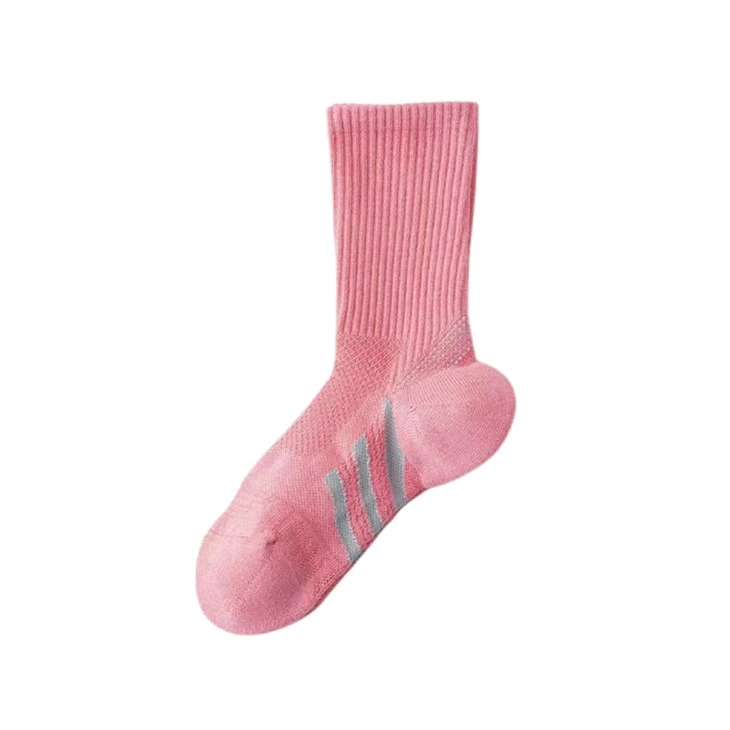
We also reinforce certain areas of the sock that are more prone to friction. The heel and the toe are two such areas. These parts of the foot come into contact with the shoe more frequently and with greater force during running. We use thicker and more durable materials in these areas to provide extra protection. The reinforced heel and toe not only reduce friction but also increase the lifespan of the sock.
Real - World Benefits of Our Friction - Reducing Socks
Many runners who have tried our socks have reported significant improvements in their running experience. For example, a long - distance runner who used to suffer from blisters on every run found that after switching to our Striped Running Socks, he was able to complete his runs without any blisters. The softness of the merino wool and the seamless design made a big difference.
Female runners have also benefited from our products. Our Black Running Socks Womens are designed specifically to meet the needs of women's feet. The targeted compression and proper fit ensure that there is minimal friction, allowing women to run comfortably for longer distances.
For those who prefer ankle - length socks, our Women's Running Ankle Socks are a great choice. They provide the same friction - reducing features in a shorter style, which is perfect for warm - weather running or for those who prefer a less bulky sock.
Conclusion
Friction is a significant factor that can affect a runner's performance and comfort. As a running socks supplier, we are committed to providing high - quality socks that effectively handle friction. Through careful material selection, specialized knitting techniques, and reinforced areas, our running socks are designed to minimize the negative effects of friction.
If you're a retailer looking to stock high - performance running socks or a running club interested in bulk purchases, we'd love to hear from you. Contact us to discuss your requirements and start a procurement negotiation. We're confident that our running socks will meet your needs and exceed your expectations.
References
- “The Science of Socks: How Materials Affect Performance.” Running Research Journal, Vol. 12, Issue 3, 2020.
- “Friction and Footwear: A Review of the Literature.” Journal of Sports Medicine and Physical Fitness, Vol. 45, Issue 2, 2005.
- “Merino Wool: Properties and Applications in Sports Apparel.” Textile Research Journal, Vol. 82, Issue 7, 2012.